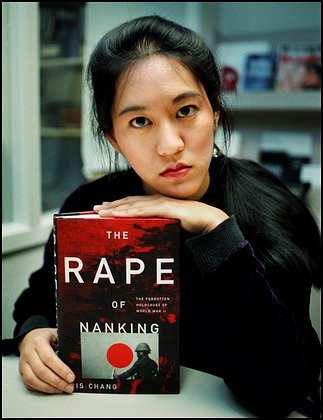
 Iris Chang
 March 28, 1968 – November 9, 2004
Her most notable work was The Rape of Nanking which documented the Japanese genocidal atrocities, which led to the deaths of over 200,000 Chinese citizens. She was propelled into the spotlight, becoming a beacon for controversy for Japanese officials seeking to obscure the massacre, but more importantly the voice for those were lost & those who lived. What happened to make Iris Chang commit suicide? No one can say for certain, but towards the end of her life she was experiencing paranoid delusions about the government tracking her. She was briefly committed, but it seemed to have little effect in aiding any recovery.
What we do know about her death
 1. Chang had been very depressed, she was searching online for suicide methods, plus she had read this book: Final Exit: The Practicalities of Self-Deliverance and Assisted Suicide for the Dying by Derek Humphry - Buy it here http://www.amazon.com/Final-Exit-Third-Practicalities-Self-Deliverance/dp/0385336535/ref=pd_bbs_sr_1?ie=UTF8&s=books&qid=1237103909&sr=8-1 or check it out from your local library. (I do not recommend you purchase it, as any information it contains will not be useful to those who want an easy death. It deals mainly with prescription drugs, which would be difficult for most people to obtain.)*
2. Chang used a replica Civil War gun to shoot herself, with one shot through the mouth while sitting in her car. She used a replica, because in CA, if you have been committed, you are restricted from buying any other type of gun than a replica. (Even when her mind was collapsing, the lady could still research!)
3. Chang left behind three suicide notes, which could imply that she had doubts about what she was going to do or as the perfectionist that she was, wanted to get the message perfectly clear. (See below.)
Iris Chang's suicide notes
The first note:
I promise to get up and get out of the house every morning. I will stop by to visit my parents then go for a long walk. I will follow the doctor's orders for medications. I promise not to hurt myself. I promise not to visit Web sites that talk about suicide.The second note:
When you believe you have a future, you think in terms of generations and years. When you do not, you live not just by the day — but by the minute. It is far better that you remember me as I was — in my heyday as a best-selling author — than the wild-eyed wreck who returned from Louisville... Each breath is becoming difficult for me to take — the anxiety can be compared to drowning in an open sea. I know that my actions will transfer some of this pain to others, indeed those who love me the most. Please forgive me. Forgive me because I cannot forgive myself.The third note:
There are aspects of my experience in Louisville that I will never understand. Deep down I suspect that you may have more answers about this than I do. I can never shake my belief that I was being recruited, and later persecuted, by forces more powerful than I could have imagined. Whether it was the CIA or some other organization I will never know. As long as I am alive, these forces will never stop hounding me.
Days before I left for Louisville I had a deep foreboding about my safety. I sensed suddenly threats to my own life: an eerie feeling that I was being followed in the streets, the white van parked outside my house, damaged mail arriving at my P.O. Box. I believe my detention at Norton Hospital was the government's attempt to discredit me.
I had considered running away, but I will never be able to escape from myself and my thoughts. I am doing this because I am too weak to withstand the years of pain and agony ahead.
After Iris Chang
The shock of Chang's death had led some to believe that she was not lying about the CIA's involvement in her life. Particularly to those, especially Asians, who witnessed the backlash she received upon publication of her book concerning the Nanking Massacre, believe that the government was involved in her murder. For some, there is no reason why a beautiful, intelligent woman with a loving family & thriving career would take her own life, so the pain of her death is replaced with anger towards an invisible enemy. (Some of her fans are discussing her death here, as a question to whether or not it was murder: http://bbs.chinadaily.com.cn/viewthread.php?tid=236193&page=1) Those of us who have studied the topic or experienced suicidal thoughts of our own will attest that success in life will never guarantee success in battling disease of the mind.
One work attempting to discover the real Iris Chang & why she committed suicide is Finding Iris Chang: Friendship, Ambition, and the Loss of an Extraordinary Mind written by her friend Paula
 Kamen. It is a sincere effort, from someone who clearly wanted to get to the bottom of why her friend's life took this horrific turn. Kamen does not explicitly or implicitly state why Chang took her life, but she carefully & respectfully pealed away the layers of Chang's outwardly perfect life to reveal the shambles it lay in before she died. She did discuss the conspiracy theories briefly, but did not indulge in giving them any credibility. (OK one gripe I have, not concerning the book, is how Iris Chang's husband got engaged to & impregnated another woman less than a year after his wife died. Oh & she was Chinese-American & named Iris too. Is it impossible for men to deal with their grief without running into the arms of another woman? Are they not supposed to be the stronger sex according to tradition?)
UPDATE - 08/August/2013 - Since blog commentators were kind to point out the misinformation from Kamen's book, I'd like to apologize for what I wrote about Iris's husband Brett. I hope he (&his family) are leading a happy life. Thank you.
The Last Word
Personally, I will always remember sitting near the TV down the hall in my dorm & hearing how this woman, whose work I adored, had taken her life. I could not understand why she did it, but inherently I knew she had her reasons. The following day, I went to the library to rent a few of her books, but was disappointed to see that every book was out. When I did have the opportunity to reread them, I was reminded of her overwhelming talent for writing history. Her books are all very accessible, even to those without much of an interest in nonfiction & Asian(-American) history.
Links
- http://www.sfgate.com/cgi-bin/article.cgi?file=/c/a/2005/04/17/CMGCNBQRRP1.DTL&type=books
- http://www.nytimes.com/2004/11/12/arts/12chang.html
*I will be reviewing the book by Derek Humphry at a later date & include information about the Hemlock Society.


 Posts
Posts

